We’ve made impossible the new normal. Somewhere along the way, the expectations placed on marketers, agencies and businesses have become almost impossible to reconcile.
Do more with less. Move faster without compromising quality. Be more creative, analytical, strategic, and accountable. All at once. And just as we begin to figure things out, the rules change again.
The uncomfortable truth is that our industry has spent years asking people to achieve the impossible without fundamentally changing how they work. Perhaps it’s time we did.
The Impossible Talent
Consider what we expect from marketing talent today.
We want strategists who understand technology. Creatives who understand data. Account leaders who can advise on business transformation. Marketers who can navigate algorithms, customer experience, commerce, content, culture and increasingly, artificial intelligence.
We want specialists who can be generalists. Thinkers who can execute. Creative minds who can demonstrate commercial impact.
And we want all of this at speed.
According to HubSpot’s 2026 State of Marketing research, 83.5% of marketers say they’re expected to produce more content, while nearly three-quarters report increased workloads over the previous year.
Microsoft’s 2025 Work Trend Index paints an even more concerning picture: 80% of the global workforce say they lack sufficient time or energy to do their work, while 53% of leaders believe productivity still needs to increase.
Think about that contradiction.
We’re asking people who are already stretched to become even more productive. The answer cannot simply be to work harder, learn faster or add another skill to an already impossible job description.
What if, instead of continually expanding what we expect from people, we expanded what people are capable of?
Giving strategists the ability to interrogate more information. Giving creatives the freedom to explore more possibilities. Giving account teams the intelligence to make better decisions.
Not replacing expertise but extending it. And perhaps most importantly, giving talented people back the time and space to think.
The Impossible Agency
Agencies face a similar contradiction.
Clients want deep specialisation, but increasingly expect integrated solutions. They want world-class creativity, sophisticated technology, strategic intelligence, real-time insights, measurable business outcomes and seamless execution.
They want global scale with local relevance. Bespoke thinking with operational efficiency. Greater output at lower cost. They want a specialist and a one-stop shop. And the evidence is increasingly clear.
The same research identified AI as the leading capability clients expect from agencies in the future, alongside growing expectations around strategic consultancy, operational excellence, creativity and business involvement.
The traditional agency response has been to add more capabilities, hire more specialists, build more departments or assemble more partners.
But adding complexity to solve complexity is not a sustainable operating model, and asking every agency to become brilliant at everything is equally unrealistic.
The agency of the future cannot simply be a collection of capabilities. It needs to become a connected system of intelligence, expertise and execution.
One where specialist depth is amplified rather than diluted. Where intelligence travels across disciplines and markets. Where teams can access capabilities beyond their immediate expertise without compromising quality.
This is where AI becomes an operating advantage, rather than another service on an agency’s credentials slide.
The Impossible Pace
Then there’s the pace of change itself.
Technology evolves faster than organisations can adopt it. Consumer behaviours shift faster than planning cycles. New models, platforms and possibilities emerge before we’ve fully understood the previous generation.
HubSpot’s 2026 research found that 70% of marketers believe marketing has changed more in the last three years than in the previous 50.
Whether or not we agree with that perception, it tells us something important about the pressure people feel.
The industry has become very good at discussing transformation. We have frameworks, roadmaps, maturity models, steering committees and countless presentations about the future.
And yes, some of that work is necessary. But the future doesn’t wait for the framework to be finished.
I believe the organisations that succeed won’t necessarily be those with the most sophisticated AI strategies. They’ll be the ones that can build, experiment, learn and adapt faster than the world changes around them.
More products. More pilots. More experimentation. More learning from actual use. Less time talking about what AI might do.
More time putting it to work.
The Impossible Paradox
I think there’s a useful way to visualise the challenge facing our industry.
For decades, we’ve operated along two dimensions: the breadth of capabilities we can offer and the capacity we have to deliver them.
Traditionally, expanding one has meant stretching the other. A specialist agency can deliver depth but often lacks breadth. An integrated agency can offer breadth, but frequently introduces complexity, cost and coordination challenges.
AI creates the opportunity to change that relationship.
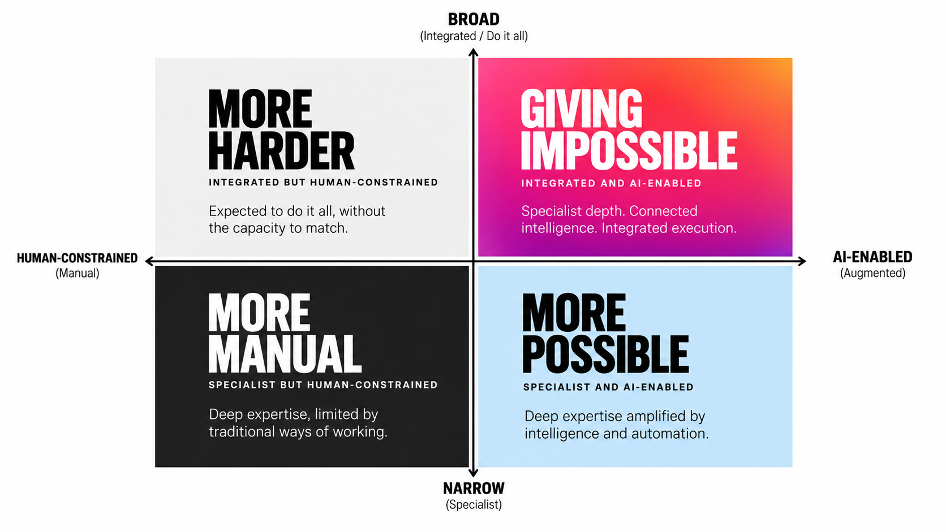
There are four operating realities. The top-right quadrant is ambition.
Not because AI makes every individual capable of doing everything, but because it allows organisations to connect capabilities in ways that were previously too slow, expensive or complex.
It changes the economics of expertise. It changes the relationship between ambition, audacity and capacity.
And it challenges our assumptions about how an agency needs to be organised.
Giving The Impossible
This thinking is also shaping what we’re building at TEAM LEWIS.
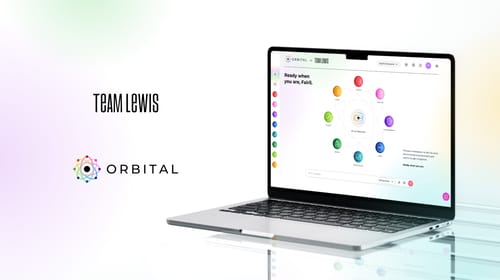
With Orbital, our intelligent marketing operating system, we’re exploring how intelligence, strategy, creativity, activation and performance can work together in a more connected environment.
To rethink how marketing and growth operations happen. Not simply to automate tasks or generate more output. To give talented people capabilities they previously couldn’t access. To give specialist teams the ability to deliver more integrated solutions. To give organisations the ability to move from insight to action with greater speed and confidence.
We’re still building, piloting and learning. And I think that’s exactly how it should be.
Because buying a collection of AI tools is not the same as transforming how a business operates. The real work is redesigning workflows, connecting intelligence, building products and continuously learning from what happens when people actually use them.
Technology alone won’t solve the industry’s contradictions. We still need judgement, imagination, expertise, governance and the courage to change established ways of working.
But it gives us a new starting point.
For too long, impossible has been something we’ve demanded from our people. Impossible deadlines. Impossible briefs. Impossible expectations.
What if we changed that? What if, instead of demanding the impossible, we gave people the means to achieve it?
Because the greatest promise of AI is enabling work, ideas and outcomes that previously sat beyond our reach.
We’ve spent decades expanding what we expect from people. It’s time we expanded what people are capable of.