For years, I’ve worked with companies on their communication strategy. It usually starts with this: “We know what we want to say, here’s how we are going to say it.” But in today’s world where everyone is under a microscope, change unfolds faster than ever, and people have stronger platforms to speak their minds, things rarely go to plan. Frequently, they report back, often through survey data, that they aren’t seeing the understanding and alignment they had hoped. Further jeopardizing the speed at which they can achieve desired business outcomes.
And then the vicious cycle begins. The teams closest to the executive that owned and delivered the communication plan spend countless hours wordsmithing. Trying to decipher if a statement should be said with fewer words. If their strategy needs an easy to remember acronym or clever naming system. Have you been here, too? Let me validate your efforts. Sometimes those methods are needed. But most of the time, that’s a surface level approach that doesn’t fix the real problem at hand. Here’s where change management methodologies could make all the difference.
If you are questioning why a change management model has any relevance to corporate communications, let me pose this: People have very few ways of conveying information to each other. Every communication is an attempt to change something. Belief. Behavior. Perception. But nearly two-thirds of all major changes in organizations fail (Beyond the Wall of Resistance, 2010). HBR has even reported up to a 70% failure rate. We know that organizations are responding to change faster than they ever have before, and navigating their own significant change in the process.
There’s a field (yes, change management) that has been studying how people receive information, respond to change, and accelerate change efforts. And yet, I rarely hear about these methodologies when I’m working with communications teams.
Early in my career, when I was transitioning from finance to the world of marketing (a story for another day), I went back to school to get a master’s degree in change management. As an only child, I always found it deeply interesting how siblings behaved, worked out their challenges, and created “sibling systems.” Over time, that interest shifted to how people operate in groups: sports teams, project groups, neighborhood crews. I was fascinated by why group dynamics change collaboration, decision making and, ultimately, outcomes. And even more fascinated by how these elements change in a business setting.
After completing my master’s, I gained more experience in the field of communications. Countless executives all trying to ensure their business strategy was understood by investors, shareholders, employees, extended leadership teams, customers, and prospects. It wasn’t until I started to grow as a leader in my own career that I began working toward the same objective. Do people understand what I’m saying and why I’m saying it? Is this making sense for them? Are they bought in? What isn’t working?
Around this same time, I started working with a brilliant executive coach (hi, Susan!). She brought forward a model that has stuck with me since the day she introduced it. And no, it was not a model I learned during my master’s program, but it may be even more effective. I use it for myself regularly and I use it for clients even more. It’s called the 3 Levels of Resistance created by Rick Maurer, an organizational change consultant who has been studying the roadblocks to change in enterprise organizations for over 30 years.
Consider this model a diagnostic tool to evaluate what is not working and why when it comes to your comms strategy.
The 3 Levels of Resistance Model:
Level 1: “I don’t get it”
Level 2: “I don’t like it”
Level 3: “I don’t like you”
Each level builds depth and, therefore, builds stronger forms of resistance. Fixing an “I don’t get it” form of resistance is far easier to change than an “I don’t like you” form of resistance. Let’s talk about what this looks like in communications and how you can fix it.
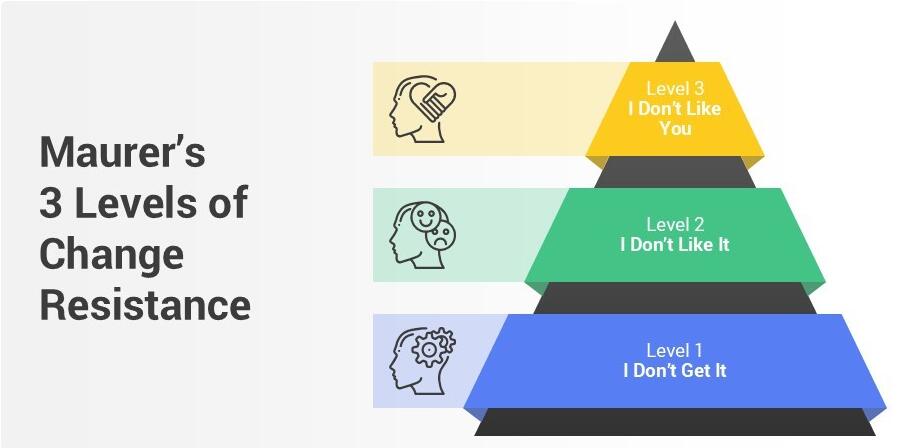
(Image Source: SlideSalad)
“I don’t get it”
This form of resistance manifests as confusion or repeated questions. For example, “I don’t think I understand,” “Can you go through that again?” or “What does this saying mean?” The good news: this is the easiest form of resistance to fix. What people are signaling is that there is an information gap at hand. The communication is not clear, it’s lacking a compelling “why,” the outcome of the approach has not been solidified, or the way the plan differs from the current state is not translating.
A quick fix for your communication strategy is clarification and simplification of the message, and use of data to validate the strategy. But enterprise organizations should take two extra steps that often go overlooked when communicating at scale and speed.
The first is creating tailored messages by role, department or division. Blanket messages, or a one-size-fits-all approach, create room for people to fill in the gaps themselves. At the coffee station, you’ll hear “What I think they mean by this is…” or “What they probably intended was….” While the overarching business strategy does apply to all, how that manifests for each division or department will look different. Spend the time to think through how you will make your communication strategy tangible one step down from the highest order of messaging.
Second, equip your next line of defense (your VPs, Directors, Managers, etc.) with talk tracks and FAQs. Nothing is more damaging to effective communications than failing to reinforce a consistent message. And we know it’s not feasible in large organizations for the C-suite to be in every meeting or conversation. As part of your communications strategy, take the time to make extended leadership communications part of the homework. If this isn’t done before the big message is communicated, you are already operating at a disadvantage.
“I don’t like it”
This form of resistance appears when people show strong emotions in response to the communication. This can be through anger, anxiety, or passive aggression (sarcasm, we are looking at you!). In this phase of resistance, people are often concerned about the impact of the change on themselves or their people. You’ll hear questions like “What does this mean for me?” “Have they even listened to the feedback I provided?” “We don’t have the training to support this,” or “How am I going to communicate this to my team?”
This form of resistance can be tricky to fix if the wrong approach is leveraged. What we don’t want to do is provide more information. Unlike “I don’t get it,” people at this level of resistance do not have an information gap problem. At least, they aren’t leading with it. What they are leading with is a risk to their sense of corporate self: their autonomy, a potential loss of status or, perhaps, a risk to income.
In this instance, the best thing we can do is listen and ask questions. If there was ever a moment to invest a little time now to save more time later, this is it! To fix it, schedule time with the individuals and groups to hear them out and ask questions to deepen your understanding. Please realize this is not a moment to restate the initial communications or defend what has been put forward. This is a moment to acknowledge emotions, seek deeper understanding and invite people to become part of the solution.
If you can’t schedule time directly with the teams or fear it wouldn’t lead to a transparent conversation, this is a good time to leverage your extended leadership teams. With either approach, the first conversation is not where a solution will be solidified. And depending on the emotional charge, it may be best to wait until the second meeting to welcome their thoughts on the solution.
But after this work has been done, adjustments to the plan and updates to your communications strategy should be made as gradually as possible. Start with the easiest wins first. For instance, if one recurring theme is that people do not feel equipped with the right skills to meet the new strategy, roll out a plan for re-skilling. But please be advised that addressing all themes in one new communications plan is ill-advised. This is about human psychology and building trust. Incremental steps go a long way in demonstrating genuine interest and care.
“I don’t like you”
This form of resistance manifests as skepticism or questioning motives behind the decisions being made. For example, “They always favor the sales organization because they were once a sales person,” “They were put into this role because of their relationship with the former CEO, they have no idea how to do the job,” or “They’re just trying to make as much money as possible.”
The list could go on, but what I want to note here is that people are not resisting the strategy or the plan itself. They may actually like the plan if it were put forward by someone else. What they are indicating is that there has been a history of failed change, perceived deceit, uneven treatment or a lack of transparency.
This is the toughest form of resistance to solve and, therefore, takes the most time. It also tends to be most present and problem-inducing in other leaders or specific individuals. It’s worth contemplating if any effort will move the needle, which can only be assessed based on how fractured the relationship has become.
If you believe this can be fixed, here’s how to do it. First, you need to find a mediator. Someone who can become a trust bridge from one person to the other. Please don’t skip this step. Then, apply the same tactics as you would for “I don’t like it.” Create space for listening and ask questions to further your understanding. Do not defend your position or provide answers in that moment.
Once armed with information, pick your quick win. What is one thing you can concede or demonstrate to build stronger trust between you and the other person? Then schedule more time with that person. In this conversation, you want to address three items specifically:
- Demonstrate where you are willing to make concessions, using your quick win as evidence.
- Explain your decision-making criteria. This is the art of bringing others along.
- Explain how you see this person not only contributing but as an integral part of the plan and the leadership team.
It’s at this stage that you need to reinforce your appreciation for voices that challenge you and the plan, while presenting this as an invitation to participate.
Zooming out from the specific individual, communication remediation must happen in a larger forum. As the saying goes, one bad apple spoils the bunch. It’s likely that others are privy to the situation and are starting to question the validity of some statements made. For enterprise organizations, this likely won’t need to be addressed companywide, though I’ve seen organizational cultures that embrace extreme transparency do this well. Please assess the potential spread of the issue and build your remediation plan accordingly.
I’m going to say a rather obvious statement: Humans are not robots. Though, who knows if these change management strategies may be applicable to humanoids down the road. The point is that people change quite frequently. And so do their levels of resistance. Someone who is at the “I don’t like you” level may move to an “I don’t like it” level. Or people that have their information gaps filled from the “I don’t get it” level may decide that they now “don’t like it.”
The main takeaway of this entire blog is to ensure your communications strategy is agile. The way you do that is by keeping a pulse on your audiences as closely as possible, and moving away from generic communication approaches when you start to experience resistance to what has been presented. Sure, an alliteration format could make a message more memorable. But there’s more depth to how people behave in a group or business that can have a greater impact on the success of your communications plan and, therefore, business outcomes. Take it from an only child who has been observing these dynamics for years!
If your comms strategy isn’t delivering the understanding, alignment or action you need, the issue may be deeper than the message itself. Get in touch with our team to build an approach that moves your organization forward.